
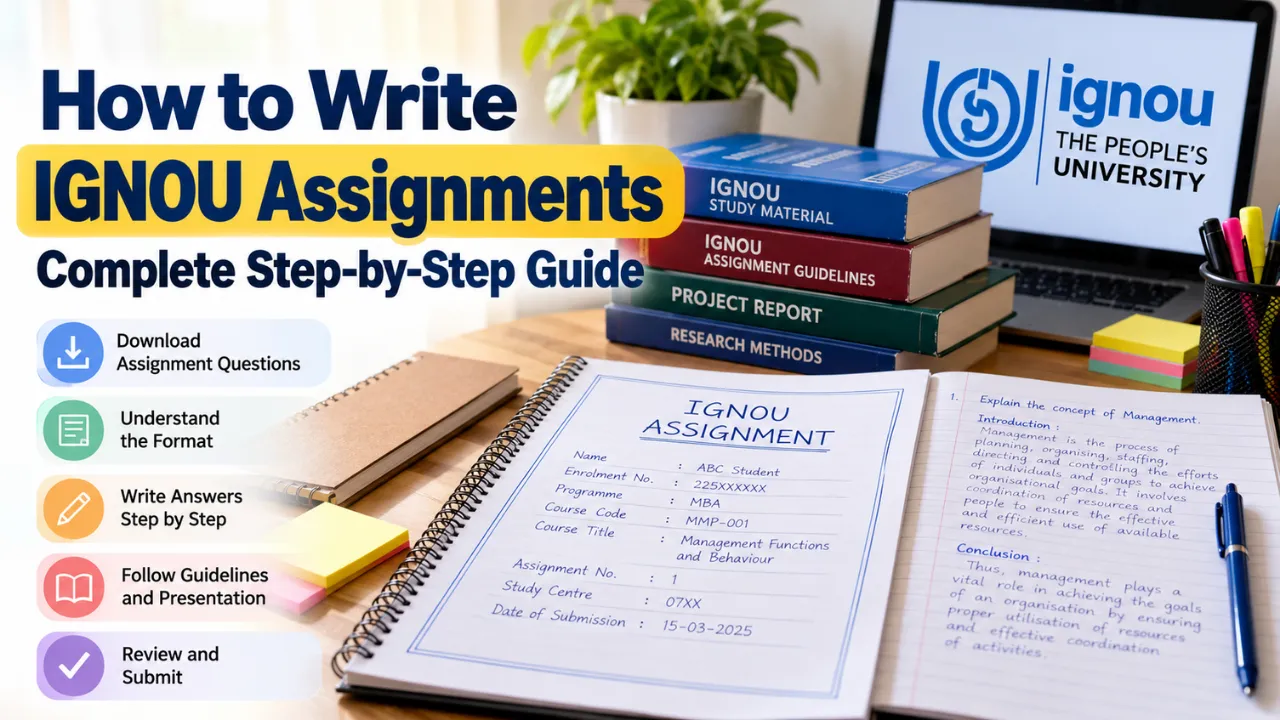
How to Write IGNOU Assignments: Complete Step-by-Step Guide
Table of Contents
How to Write IGNOU Assignments
Writing assignments is an important part of studying at the Indira Gandhi National Open University (IGNOU). Students need to understand the questions, prepare relevant answers, follow the prescribed format, and submit their work according to the applicable guidelines.
If you are unsure how to start, what to write on the first page, or how to organize your answers, this guide will help you prepare your IGNOU assignments step by step.
In this article, you will learn how to write IGNOU assignments, arrange the front page, present answers clearly, avoid common mistakes, and prepare your work for submission.
What Is an IGNOU Assignment?
An IGNOU assignment is an academic task designed to assess a student’s understanding of the subjects included in their programme. Depending on the course, assignments may include descriptive answers, short notes, numerical problems, case studies, or practical activities.
Assignments can contribute to your overall course assessment. Therefore, it is important to check the assignment questions, maximum marks, submission instructions, and applicable evaluation requirements for your programme and session.
Step 1: Download the Correct IGNOU Assignment Questions
Before writing your answers, make sure you have the correct assignment questions for your programme, course code, and academic session.
Follow these steps:
- Visit the official IGNOU website.
- Navigate to the student or assignment section.
- Find the assignment questions for your programme and relevant session.
- Check the course codes and assignment validity.
- Download and save the correct question papers.
Always use the questions applicable to your current admission session. Avoid relying on old assignment papers unless they are confirmed to be valid for your course.
Step 2: Read the Questions Carefully
Once you have downloaded the assignment, read every question before beginning your answers.
Pay attention to the instruction words used in each question.
- Explain: Describe the concept clearly and include relevant details.
- Discuss: Present the main points, different perspectives, and supporting arguments.
- Define: Provide a clear and precise meaning of the term.
- Compare: Explain the similarities and differences between two or more concepts.
- Evaluate: Examine the subject critically and present a reasoned conclusion.
- Illustrate: Explain the concept with suitable examples.
Understanding what a question requires helps you avoid irrelevant information and organize your answer more effectively.
Step 3: Understand the IGNOU Assignment Format
A clear and organized format makes your assignment easier to read and evaluate. Although the exact requirements can vary by programme, a typical handwritten assignment may include the following sections.
1. Front Page
The first page should contain the information required by the applicable assignment guidelines. Common details include:
- Student’s name
- Enrollment number
- Programme name and code
- Course title and course code
- Assignment number or session, where applicable
- Study centre name and code, if required
- Regional centre details, if required
- Date of submission, where applicable
Check your programme’s instructions before finalizing the front page.
2. Assignment Questions and Answers
Write the question number clearly before each answer. If the instructions require the questions to be reproduced, follow that requirement.
Keep answers in the same order as the original assignment unless the instructions state otherwise.
3. References
If you have used books, official study material, research papers, or other sources, include references where appropriate and follow the required citation style.
Avoid copying content from websites or other students’ assignments without proper acknowledgment.
Step 4: Prepare Answers in a Clear Structure
Before writing a complete answer, spend a few minutes organizing the main points.
A useful structure for descriptive questions is:
Introduction: Introduce the topic and explain its basic meaning.
Main explanation: Discuss the key concepts, relevant details, and supporting arguments.
Examples: Include examples, diagrams, calculations, or case studies when they are relevant to the question.
Conclusion: Summarize the main points and provide a suitable closing statement.
Not every question requires all four sections. Adapt the structure to the question and the word limit or other instructions provided.
Step 5: Write Answers in Your Own Words
Your answers should demonstrate your understanding of the subject rather than simply reproduce material from a textbook or website.
Use the following practices when preparing your answers:
- Read the relevant study material before writing.
- Identify the key concepts and important facts.
- Explain ideas in simple, clear language.
- Use subject-specific terminology where necessary.
- Add relevant examples to clarify difficult concepts.
- Check that every part of the question has been addressed.
For example, if a question asks you to explain the functions of management, organize the answer around the relevant functions and explain each one separately instead of writing a general paragraph about management.
Step 6: Follow the Word Limit and Question Instructions
Some assignments specify a word limit for each answer. Others may prescribe the number of questions to answer or provide particular formatting instructions.
Always follow the instructions printed on your assignment question paper.
When a word limit is provided, aim to answer the question completely without unnecessary repetition. A longer answer is not automatically a better answer; relevance, accuracy, clarity, and coverage of the question are important.
Step 7: Maintain Neat Handwriting and Presentation
If your programme requires handwritten assignments, ensure your writing is readable and your pages are organized.
Keep these presentation tips in mind:
- Use a consistent handwriting style.
- Leave adequate space between answers.
- Write question numbers clearly.
- Use headings and subheadings where helpful.
- Number the pages in the correct order.
- Keep diagrams and tables neat and properly labelled.
- Avoid excessive cutting, overwriting, or unnecessary decoration.
If typed assignments are permitted for your particular course, follow the prescribed document format and submission instructions.
Step 8: Use Reliable Study Material
The official IGNOU study material is a useful starting point because it is designed around the subjects taught in the programme.
You can also consult relevant textbooks, academic articles, and credible educational sources when additional explanation is needed.
While researching, make sure that the information is accurate and directly related to the question. Verify important facts and avoid including unsupported claims.
For numerical or technical questions, check calculations and ensure that the steps are explained wherever required.
Step 9: Review Your Assignment Before Submission
Before submitting your assignment, review every answer carefully.
Use this checklist:
- Have you answered all required questions?
- Are the answers relevant to the questions?
- Have you followed the prescribed format?
- Is your name and enrollment number correct?
- Have you checked the course codes?
- Are the pages arranged in the correct order?
- Have you checked spelling, grammar, and calculations?
- Are references included where needed?
- Have you followed the current submission instructions?
Correct any errors before submitting your work.
Step 10: Submit Your IGNOU Assignment According to the Guidelines
IGNOU assignment submission procedures may vary depending on the programme, study centre, and current instructions.
Check the official IGNOU website, your regional centre’s announcements, or the relevant study centre instructions to confirm the accepted submission method, deadline, and required documents.
Depending on the applicable rules, submission may involve an authorized online process or a designated offline procedure.
After submitting your assignment, retain the acknowledgment, receipt, or other proof of submission whenever available. You may need it if you later have questions about your submission status.
Common Mistakes to Avoid While Writing IGNOU Assignments
Students can improve their assignment preparation by avoiding these common mistakes.
Using the Wrong Assignment Questions
Submitting answers for an outdated session or incorrect course code can create problems. Verify the question paper before starting.
Writing Irrelevant Answers
Adding unrelated information does not necessarily improve an answer. Focus on the question and explain the relevant concepts.
Ignoring the Prescribed Format
Check the front-page details, answer requirements, word limits, and other instructions provided for your course.
Copying Content Without Understanding It
Simply reproducing material from websites or other sources does not demonstrate your understanding. Study the topic and write explanations in your own words.
Leaving Out Required Questions
Review the instructions to confirm which questions must be answered. Do not assume that every assignment follows the same question-selection rules.
Missing the Submission Deadline
Keep track of the deadline announced for your programme and session. Confirm any extensions or changes through official channels rather than relying on unverified information.
Frequently Asked Questions About IGNOU Assignments
1. How do I write an IGNOU assignment?
Download the correct assignment questions, read the instructions, prepare answers using relevant study material, follow the prescribed format, review your work, and submit it through the authorized method.
2. Is it necessary to write IGNOU assignments by hand?
Handwritten assignments are required where the applicable instructions specify them. Check your programme’s current guidelines to determine whether handwritten or typed submissions are accepted.
3. What should be included on an IGNOU assignment front page?
Common details include your name, enrollment number, programme, course code, assignment session, and study centre information where required. Follow the instructions applicable to your course.
4. Can I use online resources to prepare my IGNOU assignments?
Yes, online resources can help you understand concepts and find additional information. Prefer reliable sources, verify facts, acknowledge sources where appropriate, and prepare your answers in your own words.
5. How long should an IGNOU assignment answer be?
The required length depends on the question and the instructions provided in the assignment. Follow the specified word limit and ensure that your answer covers the relevant points.
6. How can I check my IGNOU assignment submission status?
Follow the official status-checking procedure available for your programme or contact the relevant study centre if you need clarification. Keep your submission acknowledgment or receipt for reference.
7. What should I do if I make a mistake in my assignment?
Correct mistakes before submission whenever possible. If the assignment has already been submitted, contact the appropriate study centre to ask whether any correction or resubmission is permitted.
Conclusion
Writing IGNOU assignments becomes more manageable when you follow a clear process. Start with the correct question paper, understand what each question requires, organize your answers, use reliable study material, and check your work before submission.
Remember that assignment requirements can differ across programmes and sessions. Always verify the latest official instructions before preparing and submitting your work.
For more educational resources, assignment preparation guidance, and project-related information, explore the relevant sections of IGNOUProjects.in and find resources suited to your academic requirements.


