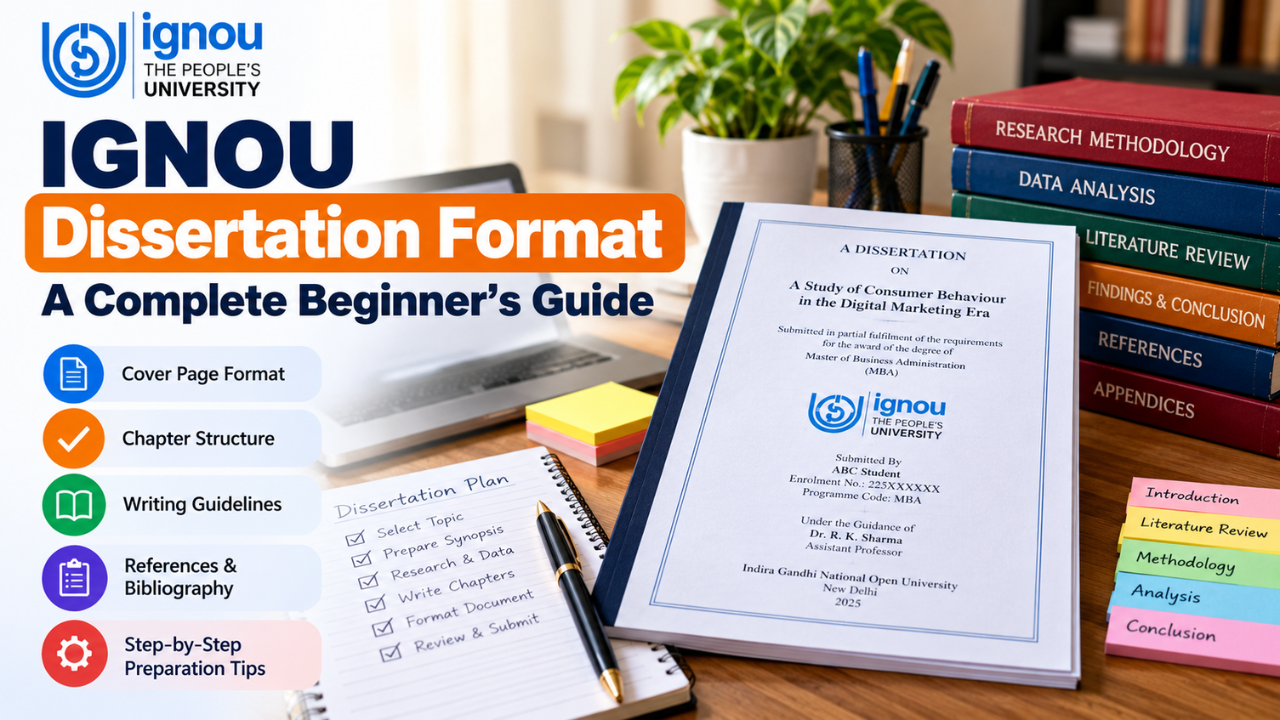
IGNOU Dissertation Format: A Complete Beginner’s Guide
Table of Contents
Preparing a dissertation can seem challenging, especially if you are writing one for the first time. From selecting a research topic to organizing chapters and formatting references, every stage requires careful planning and attention to academic guidelines.
Understanding the IGNOU dissertation format is an important first step. A well-organized dissertation presents your research clearly, follows the required structure, and helps readers understand your findings.
In this guide, you will learn about the common sections of a dissertation, how to prepare each chapter, formatting considerations, and mistakes to avoid before submission. Since requirements can differ between IGNOU programmes, always check the latest guidelines applicable to your course.
What Is an IGNOU Dissertation?
An IGNOU dissertation is an academic research document prepared as part of a programme that requires a dissertation or research project. It allows students to explore a specific topic, review existing research, select an appropriate methodology, analyze information, and present their conclusions.
The exact nature of the work depends on the programme. Some courses require a research dissertation, while others require a project report, fieldwork report, or another form of academic submission.
Before beginning, confirm the applicable project requirements, approval process, supervisor instructions, and submission procedure for your programme.
IGNOU Dissertation Format and Structure
A dissertation generally contains preliminary pages, research chapters, references, and supporting appendices where necessary. The exact order and required sections should follow your programme’s official guidelines.
A common dissertation structure is outlined below.
1. Cover Page
The cover page introduces your dissertation and provides essential academic details.
It may include:
- Title of the dissertation
- Student’s name
- Enrollment number
- Programme name and code
- Name of the university
- Study centre or regional centre details, where required
- Supervisor’s name and designation, where applicable
- Academic session or year of submission
Keep the cover page neat and professional. Use the exact title approved for your research and follow the prescribed cover-page template if one is provided.
2. Certificate
A certificate may be required to confirm that the research work was completed under the supervision of an approved guide.
The certificate’s wording, format, and signature requirements depend on the programme. Use the prescribed template instead of preparing an unofficial version.
3. Declaration
A declaration generally confirms that the submitted work is the student’s own research and that sources have been appropriately acknowledged.
If your programme requires a declaration, include the approved wording and any requested signature or date details.
Do not include a declaration unless it is appropriate for your submission requirements.
4. Acknowledgement
The acknowledgement section allows you to thank people who supported your research, such as your supervisor, faculty members, research participants, or others who provided relevant assistance.
Keep this section concise, professional, and specific to your actual research experience.
5. Abstract or Executive Summary
An abstract provides a short overview of the dissertation. It typically explains:
- The research topic and background
- The main research objective
- The methodology used
- The key findings
- The principal conclusion
Write the abstract after completing the main research so that it accurately reflects the work. Follow the word limit specified by your programme.
6. Table of Contents
The table of contents lists the chapters and major sections of the dissertation along with their page numbers.
Make sure the headings match those used in the dissertation. If you are using a word processor, an automatically generated table of contents can help keep page numbers accurate after editing.
7. List of Tables, Figures and Abbreviations
Include these lists when your dissertation contains tables, figures, charts, or abbreviations that readers may need to locate.
Use consistent numbering and descriptive titles. Each table or figure should be referred to in the relevant section of the text.
How to Write Each Chapter of an IGNOU Dissertation
The chapter structure depends on the subject and approved research plan. The following is a common framework for research-based dissertations.
Chapter 1: Introduction
The introduction explains the subject of the research and why it deserves investigation.
It may include:
- Background of the study
- Statement of the research problem
- Rationale or significance of the study
- Research objectives
- Research questions or hypotheses, where applicable
- Scope of the study
- Limitations of the research
- Organization of the dissertation
Start with the broader context and gradually narrow the discussion to the specific issue being investigated.
Chapter 2: Review of Literature
The literature review examines relevant books, research papers, reports, and previous studies related to your topic.
Its purpose is not simply to summarize existing sources. It should identify important themes, compare findings, discuss differences between researchers, and explain how your study relates to previous work.
Use credible academic sources and cite them consistently. Identify research gaps only when they are supported by your review.
Chapter 3: Research Methodology
This chapter explains how the research was conducted.
Depending on the subject, it may cover:
- Research design
- Research approach
- Population and sample
- Sampling technique
- Data collection methods
- Research instruments
- Data analysis techniques
- Ethical considerations
For example, a study based on questionnaires should explain how participants were selected, how the questionnaire was developed, and how the responses were analyzed.
Choose methods that are suitable for your research objectives and explain the reasons for your choices.
Chapter 4: Data Analysis and Interpretation
This chapter presents and explains the findings obtained through your research.
Depending on the study, you may use tables, graphs, descriptive statistics, thematic analysis, or other appropriate methods.
Every table and figure should have a clear title and be discussed in the text. Explain what the results mean instead of presenting data without interpretation.
Do not invent responses, observations, statistics, or research findings. All reported results should come from the actual research or properly identified secondary sources.
Chapter 5: Findings, Conclusion and Recommendations
This chapter brings together the main results and explains how they address the research objectives.
It may include:
- Summary of major findings
- Conclusions drawn from the analysis
- Practical recommendations, where relevant
- Limitations of the research
- Suggestions for future research
Make sure the conclusions follow from the evidence presented in earlier chapters. Avoid introducing major new findings that have not been discussed previously.
Some programmes may require separate chapters for findings, discussion, conclusions, or recommendations. Follow the structure prescribed for your course.
References and Bibliography
The references section lists the sources cited in your dissertation. These may include books, journal articles, official reports, and credible online publications.
Use the citation style specified by your programme or supervisor. Apply it consistently throughout the document.
Check that every in-text citation has a corresponding reference entry and that all bibliographic details are accurate.
A bibliography may include additional sources consulted during the research, depending on the requirements. Do not treat references and bibliography as interchangeable if your programme distinguishes between them.
Appendices
Appendices contain supporting materials that are useful for understanding the research but would interrupt the main discussion if included in the chapters.
Depending on your study, appendices may include:
- Questionnaire or interview schedule
- Additional tables
- Supporting documents
- Research instruments
- Other relevant supplementary material
Label each appendix clearly and refer to it in the main text where appropriate. Do not include confidential personal information without proper authorization.
IGNOU Dissertation Formatting Guidelines
The correct formatting requirements must come from the guidelines for your programme. If no specific requirement has been provided, the following practices can help you prepare a readable academic document.
Page Layout and Font
Use consistent page margins, font style, font size, paragraph spacing, and line spacing throughout the dissertation.
Do not assume that one font size or margin setting applies to every IGNOU programme. Confirm the prescribed settings before finalizing your document.
Page Numbering
Use a consistent page-numbering system. Preliminary pages and main chapters may follow different numbering conventions where required.
Check the final page numbers after completing the document and updating the table of contents.
Headings and Subheadings
Use a clear hierarchy for chapter titles, section headings, and subsections. Consistent headings make your dissertation easier to navigate and review.
Avoid unnecessary decorative fonts, excessive colours, and inconsistent text alignment.
Tables, Charts and Figures
Number tables and figures consistently, give each a descriptive title, and identify the source of externally obtained material.
Ensure that charts and tables are readable and directly relevant to your research objectives.
Citation and Academic Integrity
Acknowledge all sources that contribute ideas, quotations, data, or other material to your research.
Paraphrasing does not remove the need to cite the original source. Follow your programme’s academic integrity and plagiarism policies, and ensure that the final dissertation reflects your own research and understanding.
Step-by-Step Process to Prepare an IGNOU Dissertation
If you are unsure where to begin, follow this practical sequence.
Step 1: Understand the requirements. Read the latest project or dissertation guidelines for your programme.
Step 2: Select a research topic. Choose a manageable subject that fits your course and interests.
Step 3: Prepare the proposal or synopsis. Develop your research objectives, questions, and proposed methodology. Obtain approval where required.
Step 4: Review existing research. Read relevant academic sources and record accurate citation details.
Step 5: Collect and analyze data. Use appropriate methods and maintain accurate research records.
Step 6: Draft the chapters. Write the introduction, literature review, methodology, analysis, and conclusion according to your approved structure.
Step 7: Format the document. Arrange the preliminary pages, chapters, references, and appendices in the prescribed order.
Step 8: Proofread and verify. Check the accuracy of the content, citations, formatting, and page numbering.
Step 9: Complete the required approvals. Obtain any necessary supervisor signatures, certificates, or approvals.
Step 10: Submit according to the instructions. Verify the current submission method, deadline, and required documents before submitting the final dissertation.
Common Mistakes to Avoid in an IGNOU Dissertation
Students should pay attention to the following issues when preparing their dissertation.
Choosing a Topic That Is Too Broad
A topic that covers too many issues can make the research difficult to complete. Narrow your subject to a specific problem, group, location, or research question.
Ignoring the Approved Research Proposal
If your programme requires an approved synopsis or proposal, ensure that the final dissertation remains consistent with the approved objectives and methodology. Seek guidance before making substantial changes.
Using Unreliable Sources
Avoid relying exclusively on unverified websites or unsupported online claims. Use relevant academic literature and authoritative sources.
Inconsistent References
Missing citations, incomplete reference entries, and inconsistent formatting can weaken the presentation of your research. Review all references before submission.
Poor Chapter Organization
Each chapter should serve a clear purpose and connect logically to the next. Follow the structure required by your programme rather than copying a generic template without checking it.
Last-Minute Formatting
Leaving page numbering, tables, references, and the contents page until the final moment can create avoidable errors. Review formatting throughout the writing process.
IGNOU Dissertation Preparation Checklist
Before submitting your dissertation, confirm that you have:
- Selected a suitable topic and obtained approval where required.
- Followed the applicable dissertation guidelines.
- Included all mandatory preliminary pages.
- Organized the chapters according to the approved structure.
- Presented genuine and accurately analyzed research findings.
- Cited sources and prepared references correctly.
- Checked tables, figures, appendices, and page numbering.
- Proofread the document for spelling and grammatical errors.
- Completed all required certificates, declarations, and signatures.
- Verified the latest submission instructions and deadline.
Frequently Asked Questions About IGNOU Dissertation Format
1. What is the correct IGNOU dissertation format?
The correct format depends on your programme and its current guidelines. A typical dissertation includes a cover page, required preliminary sections, an abstract, a table of contents, research chapters, references, and appendices where applicable.
2. How many chapters should an IGNOU dissertation have?
The number of chapters depends on the programme, subject, and approved research plan. Many research dissertations use an introduction, literature review, methodology, analysis, and conclusion, but you should follow your programme’s specific requirements.
3. Is a synopsis required before preparing an IGNOU dissertation?
Some programmes require a synopsis or project proposal and approval before the full report is prepared. Check your course-specific instructions to confirm the process.
4. What should be included in an IGNOU dissertation cover page?
Common details include the dissertation title, student’s name, enrollment number, programme, university, and relevant supervisor or study centre details. Use the official template if your programme provides one.
5. Can I use a sample dissertation to prepare my report?
A sample dissertation can help you understand structure and presentation. However, your topic, analysis, writing, and conclusions should reflect your own research. Cite sources properly and do not submit another student’s work as your own.
6. How do I choose an IGNOU dissertation topic?
Select a topic related to your programme that is sufficiently focused, researchable, and supported by accessible sources or data. Consider the research objectives, time available, and guidance provided by your supervisor.
7. Where can I find IGNOU dissertation guidelines?
Start with the official IGNOU website and the relevant school, programme, regional centre, or study centre instructions. Confirm that the guidelines apply to your specific course and session.
Conclusion
Understanding the IGNOU dissertation format helps you plan your research, organize chapters, present findings, and prepare a professional academic document.
Begin by checking your programme’s requirements, selecting a suitable research topic, and preparing an approved proposal where necessary. Then work through the research and writing stages systematically, maintain accurate references, and review the complete document before submission.
For additional academic resources, project preparation guidance, and information about research report structure, explore the relevant resources available on IGNOUProjects.in.